Cairo International Conference 2027 Extends Abstract Submission Deadline to November 30 and Announces the Formation of Its Scientific, Advisory, and Preparatory Committees
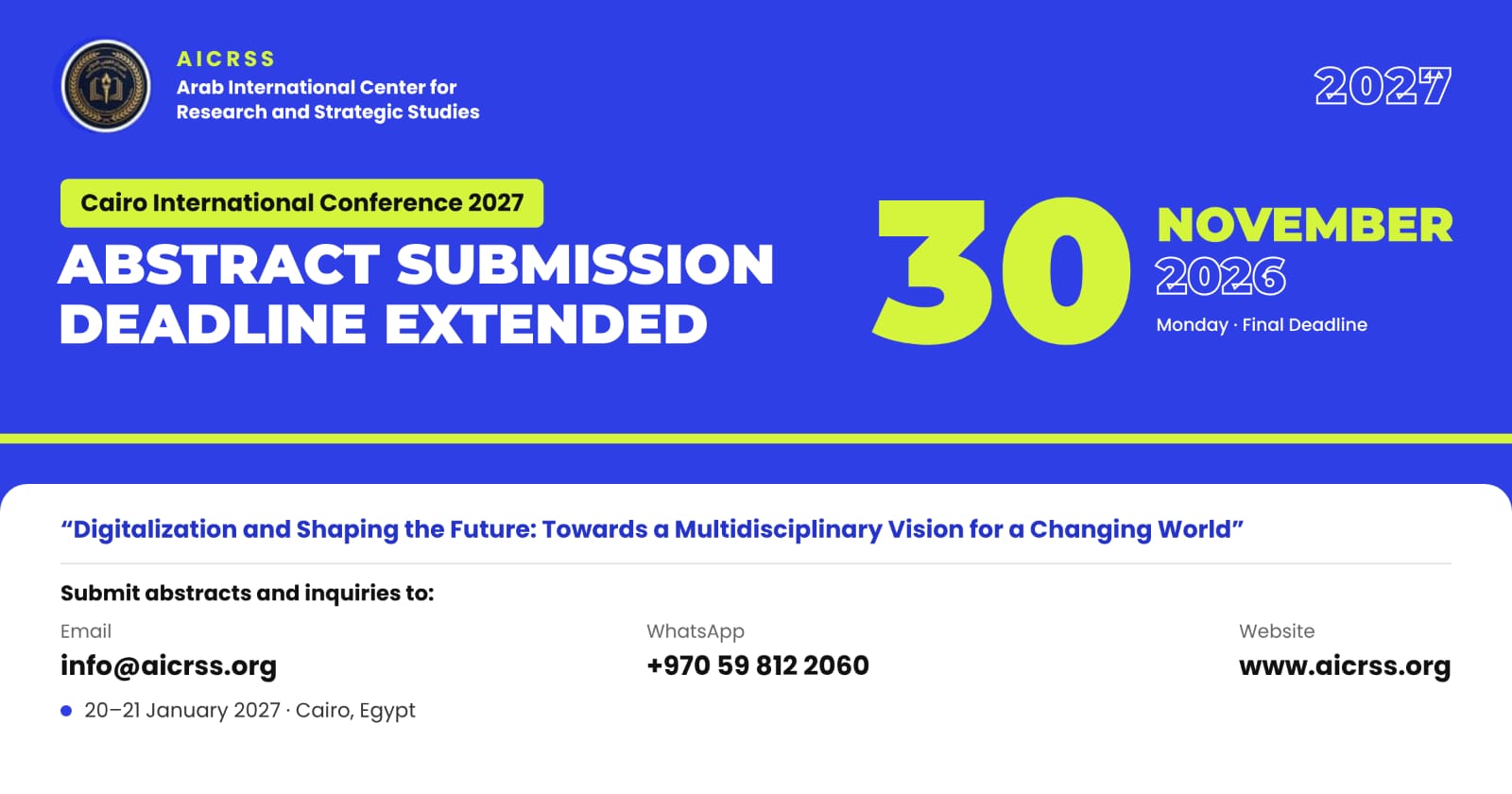
The Arab International Center for Research and Strategic Studies (AICRSS) has announced an extension of the deadline for submitting research abstracts to the Cairo International Conference 2027, entitled “Digitalization and the Making of the Future: Toward a Multidisciplinary Vision of a Changing World,” until November 30, 2026, replacing the previous deadline of November 20, 2026.
The extension comes in response to requests from a number of researchers and aims to provide academics, researchers, and specialists with additional time to prepare their abstracts and submit their proposals for participation in the conference.
The conference is scheduled to take place on January 20–21, 2027, in Cairo, Egypt, bringing together academics, researchers, experts, and specialists from Arab and international universities and research institutions. It will provide a multidisciplinary academic platform to examine rapid digital transformations and their implications across political, economic, social, scientific, and technological fields.
The conference is organized amid growing interest in examining the transformations driven by digitalization, artificial intelligence, and advanced technologies, exploring their future prospects, and strengthening scientific dialogue and interdisciplinary knowledge integration.
Conference Presidency and Organizing Committees
The conference is chaired by Prof. Dr. Mahmoud Ismail, Professor of Media at Ain Shams University, Egypt.
Advisory Committee
The Advisory Committee is chaired by Dr. Mohammad Wissam Amer, Visiting Scholar at the University of Cambridge, United Kingdom.
Its members include:
-
Prof. Dr. Al-Arabi Bouamama, Director of the Communication Studies Laboratory, University of Mostaganem, Algeria.
-
Dr. Ahmad Abu Diya, Professor of Political Science, Palestine.
-
Dr. Habes Shrouf, President of the Palestine Institute for National Security Research.
-
Mr. Osama Qutaina, Media Expert and Consultant to several Arab media institutions, Palestine.
-
Dr. Hamdi Mahmoud, Editor-in-Chief of Political Trends Magazine, Egypt.
Scientific Committee
The Scientific Committee is chaired by Dr. Ahmad Mohammad Maghari, Associate Professor.
Its members include:
-
Dr. Ahmad Sabri Ahmad Abu Laban, Assistant Professor, Canadian International College, Cairo, Egypt – Computer Science.
-
Dr. Nihad Hussein Al-Jamal, Assistant Professor, Al-Ahram Canadian University, Egypt – Management Information Systems.
-
Prof. Dr. Jaafar Abu Sa'a, Professor, Palestine Technical University – Kadoorie, Palestine – Educational Administration.
-
Dr. Omar Mohammad Hawatmeh, Associate Professor, University of Jordan, Jordan – Accounting and Governance.
-
Dr. Yousef Ahmad Mohammad Yousef, Assistant Professor, Al-Aqsa University, Palestine – Management Information Systems.
-
Dr. Eyad Bandar, Director of the Arab and Regional Studies Unit at the Palestine Institute for National Security Research, and Adjunct Assistant Professor at Al-Istiqlal University – Political Science.
-
Dr. Siham Fawzi, Assistant Professor, Future University, Egypt – Political Science.
-
Dr. Hassan Mohammad Ahmad, Assistant Professor of Media and Vice President of Palestine University for Public Relations and Media Affairs – Social Media.
-
Dr. Iman Ibrahim El-Sayed, Assistant Professor, American Open University, Egypt – Media and Public Relations.
-
Dr. Hanan Adnan Al-Aklouk, Associate Professor, Tampere University, Finland – Media and Visual Communication, and Visiting Researcher.
-
Dr. Omran Ali Alyan, Associate Professor, Al-Istiqlal University, Palestine – Sociology.
-
Dr. Amna Abdel Hamid Zaqout, Associate Professor, King's College London, United Kingdom – Psychology and Mental Health.
-
Prof. Dr. Massoud Hussein Al-Taib, Professor, University of Sabratha, Libya – Media.
-
Dr. Ghassan Harb, Associate Professor, Al-Aqsa University, Palestine – Radio and Television.
-
Dr. Ahmad Ibrahim Hammad, Associate Professor, Al-Aqsa University, Palestine – Public Relations.
-
Dr. Sameh Jamil Al-Ajrami, Associate Professor, Al-Aqsa University, Palestine – Educational and Information Technology.
-
Dr. Asim Shawqi Obeid, Associate Professor, Palestine Technical University – Kadoorie, Palestine – Educational Administration.
-
Dr. Ahmad Abdel Majeed Al-Mabhouh, Associate Professor, Al-Aqsa University, Palestine – Educational Technology.
-
Dr. Ayyoub Ragheb Al-Dalo, Associate Professor, University of Houston, Texas, United States – Medical Biochemistry, and Adjunct Professor.
-
Dr. Islam Rasem Al-Bayari, Associate Professor, Al-Istiqlal University, Palestine – International Law.
-
Dr. Badr Zama'ra, Assistant Professor, Gaza University, Palestine – International Law and Human Rights.
-
Dr. Mohammad Amer, Associate Professor, Palestine Technical University – Kadoorie, and Head of the Mechanical Engineering Department.
Preparatory Committee
The Preparatory Committee is chaired by Mr. Mohammad Faraj and includes:
-
Dr. Ziad Al-Shakhanbeh.
-
Dr. Mahmoud Barakeh.
-
Mr. Niaz Deifallah.
-
Dr. Mohammad Kamal Sultan.
-
Mr. Mohammad Sultan.
-
Dr. Fadi Abu Diak.
-
Dr. Mohammad Injass.
Conference Objectives
The conference seeks to achieve a range of scientific and intellectual objectives, most notably:
-
Examining digital transformations and their implications for societies, states, and the international system.
-
Exploring applications of artificial intelligence and advanced technologies across various fields.
-
Promoting knowledge integration between the humanities, social sciences, applied sciences, and natural sciences.
-
Analyzing the political, economic, social, and institutional impacts of digital transformation.
-
Highlighting the role of innovation and technology in institutional development and improving service quality.
-
Addressing the ethical and legal issues associated with digitalization and artificial intelligence.
-
Anticipating the future of societies in light of accelerating digital developments.
-
Strengthening scientific communication and building research partnerships among universities, institutions, and research centers.
Target Participants
The conference welcomes faculty members at universities, researchers, academics, specialists, master's and doctoral students, experts, consultants, professionals, employees of public and private institutions, and those interested in digital transformation and artificial intelligence, in addition to research institutions and think tanks.
Scientific Themes
The conference covers eight main scientific themes, allowing researchers to submit specialized and multidisciplinary studies:
-
Digitalization, Geopolitical Transformations, and the International System.
-
Management, Economics, Governance, and Institutional Transformation.
-
Artificial Intelligence, Computer Science, and Advanced Technologies.
-
Media, Communication, Humanities, and Social Sciences.
-
Education, Pedagogy, Scientific Research, and Knowledge Innovation.
-
Health, Medical, and Life Sciences.
-
Law, Legislation, Ethics, and Human Rights.
-
Natural Sciences, Engineering, Environmental Studies, Agriculture, and Sustainable Development.
Forms of Participation
The conference offers the following participation options:
-
On-site participation with a scientific research paper.
-
Online participation with a scientific research paper.
-
Attendance without presenting a research paper.
-
Joint research participation involving researchers from different institutions or academic disciplines.
The conference also welcomes theoretical, applied, and field research, case studies, comparative studies, and interdisciplinary research.
Research Abstract Submission Guidelines
The conference has established the following requirements for research abstracts:
-
Abstracts must not exceed 300 words and may be submitted in Arabic or English in Word format.
-
The research title must be provided in both Arabic and English.
-
Each abstract must include between 3 and 5 keywords.
-
Traditional Arabic font must be used for Arabic text, and Times New Roman for English text.
-
Each abstract must include the research title, author(s), university or institutional affiliation, academic specialization, research problem, objectives, methodology, main findings or expected results, and keywords.
Full Research Paper Formatting Guidelines
Full research papers must comply with the following academic and technical specifications:
-
Papers must not exceed 15 pages, including references, tables, figures, and appendices.
-
A4 paper size must be used, with 2.5 cm margins on all sides.
-
Line spacing must be set to 1.5.
-
Traditional Arabic, size 14, must be used for Arabic text, and Times New Roman, size 12, for English text.
-
Main headings must be size 16 and bold, while subheadings must be size 14 and bold.
-
APA referencing style, 7th edition, must be followed.
The use of artificial intelligence tools is permitted for legitimate linguistic and technical assistance, provided that any substantial use is disclosed. Such tools must not be used to generate fabricated data or findings, nor may they be listed as authors of the research.
Submission and Participation Process
Participation in the conference will proceed through the following stages:
-
Submission of the research abstract to the Scientific Committee.
-
Academic evaluation of the abstract.
-
Notification of the researcher regarding the evaluation outcome.
-
Submission of the full research paper in accordance with the approved guidelines.
-
Subjecting the paper to academic peer review.
-
Completing any required revisions, where applicable.
-
Confirming the mode of participation, either on-site or online.
-
Completing participation and publication procedures.
Conference Outcomes and Academic Publication
The conference aims to provide participants with a range of academic and scientific outcomes, including:
-
Certificates of participation and research presentation, as well as acceptance confirmations according to the type of participation.
-
Publication of accepted research papers in the conference proceedings book, following evaluation, peer review, and formatting procedures, with an International Standard Book Number (ISBN).
-
Outstanding research papers may be nominated for consideration by scientific journals indexed in the Scopus database, subject to each journal's criteria and requirements. Nomination does not guarantee publication.
Conference Dates and Contact Information
Conference: Cairo International Conference 2027 – Digitalization and the Making of the Future: Toward a Multidisciplinary Vision of a Changing World.
Dates: January 20–21, 2027.
Venue: Cairo, Arab Republic of Egypt.
Abstract Submission Deadline: November 30, 2026.
Organizer: Arab International Center for Research and Strategic Studies (AICRSS).
Email: info@aicrss.org
Website: https://www.aicrss.org
WhatsApp Inquiries: https://wa.me/970598122060
Address: Al-Tireh, Ramallah, Palestine.
The Arab International Center for Research and Strategic Studies (AICRSS) invites researchers, academics, and specialists to take advantage of the extended abstract submission period and submit research papers that contribute to enriching academic discussions on digital transformations and the making of the future, while strengthening opportunities for scientific cooperation and the exchange of expertise among Arab and international universities and institutions.
← News